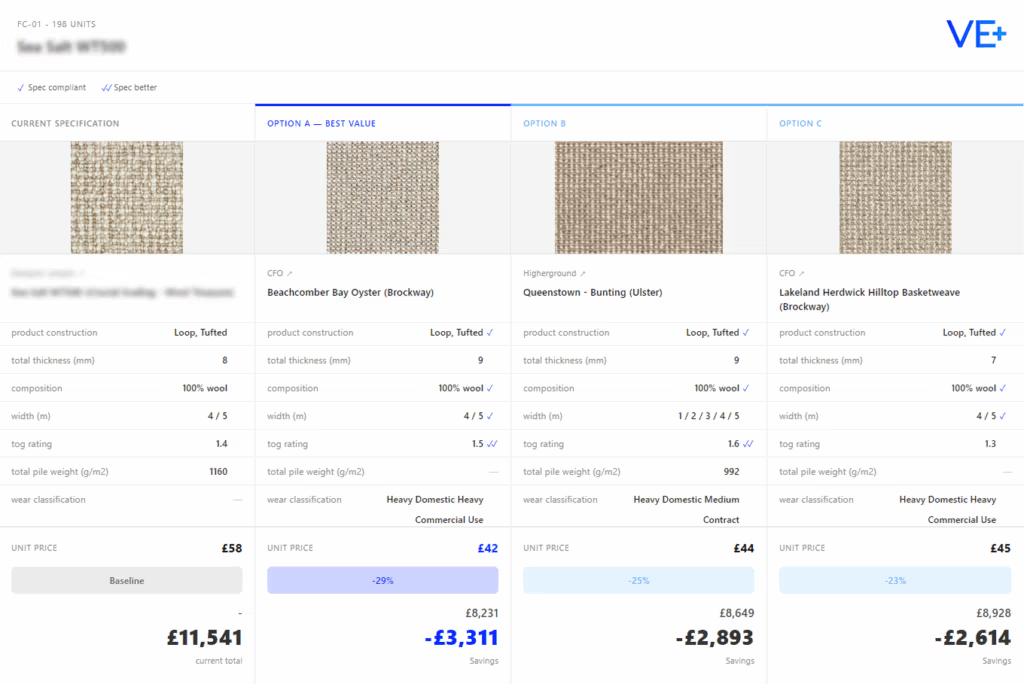
There is a common assumption in construction that if you move away from the originally specified product, you are automatically compromising something.
It might be performance. It might be appearance. It might be compliance or certification. But the underlying feeling is that “alternative” means “slightly worse.”
That assumption is understandable. Specifications are usually written carefully. Products are selected for a reason. No one wants to risk quality or introduce uncertainty without good cause.
But in many cases, the market is deeper than it first appears.
For most finishes and building products, there are multiple manufacturers producing systems that are designed to achieve very similar outcomes. They are tested to the same standards. They carry the same certifications. They are developed to meet the same performance criteria because they are operating in the same regulatory and commercial environment.
From a technical perspective, like-for-like alternatives are often not unusual at all. They are simply less visible.
The key is understanding what the original product is actually required to do.
Is it about fire rating? Slip resistance? Acoustic performance? Durability in a specific environment? A particular aesthetic? Once those requirements are clearly defined, it becomes possible to assess other products against the same criteria in a structured way.
When that review is done properly – looking carefully at test data, certifications, system build-ups, and real constraints – it is often clear that more than one product can satisfy the brief without altering intent.
Visually, many finishes within the same category are designed to compete directly with one another. Colours, formats, textures and detailing options tend to overlap because manufacturers understand the expectations of architects and clients. Performance-wise, compliance frameworks push products toward similar benchmarks.
None of this means that every product is interchangeable. Differences do exist. Details matter. Installation guidance matters. Warranty terms matter. But the idea that the specified product is the only one capable of meeting the required standard is often more about familiarity than technical exclusivity.
Like-for-like alternatives are not about downgrading. They are about verifying equivalence.
When the process is thorough, and when alternatives are assessed against the same measurable criteria as the original specification, matching look, performance and certification is not unusual. It is simply a matter of doing the work carefully.
At VE+, we focus on that careful review – making sure that when an alternative is proposed, it stands on the same technical and visual ground as the original intent.