The workflow has not changed much
Construction procurement is still, in most cases, a phone and spreadsheet operation. When a procurement team or subcontractor needs to identify an alternative product – a different cladding system, a substitute flooring finish, a compliant acoustic panel – the process that follows looks much the same as it did two decades ago. A manual search. A few emails to familiar suppliers. A wait. A manual comparison. Then the cycle repeats.
This is not because teams do not care or because the effort is not there. The limitation is structural.
The constraint is visibility
No procurement team can realistically scan the full breadth of the construction product market for every specification requirement. The market is too large, too fragmented, and too inconsistently documented. So in practice, alternatives are shaped by proximity – by who is already in the supply chain, who responds first, and who the team has worked with before.
The result is that procurement operates within a narrow band of the market, not because a wider view is unwanted, but because reaching it manually is not realistic under normal project timelines. It is a bit like walking through a large market but only ever seeing the first few stalls.
What AI changes
AI is well-suited to the part of this problem that is most constrained by manual effort: comparing large volumes of structured product data quickly and consistently. It does not tire, does not default to familiar names, and does not stop scanning at page three of a catalogue.

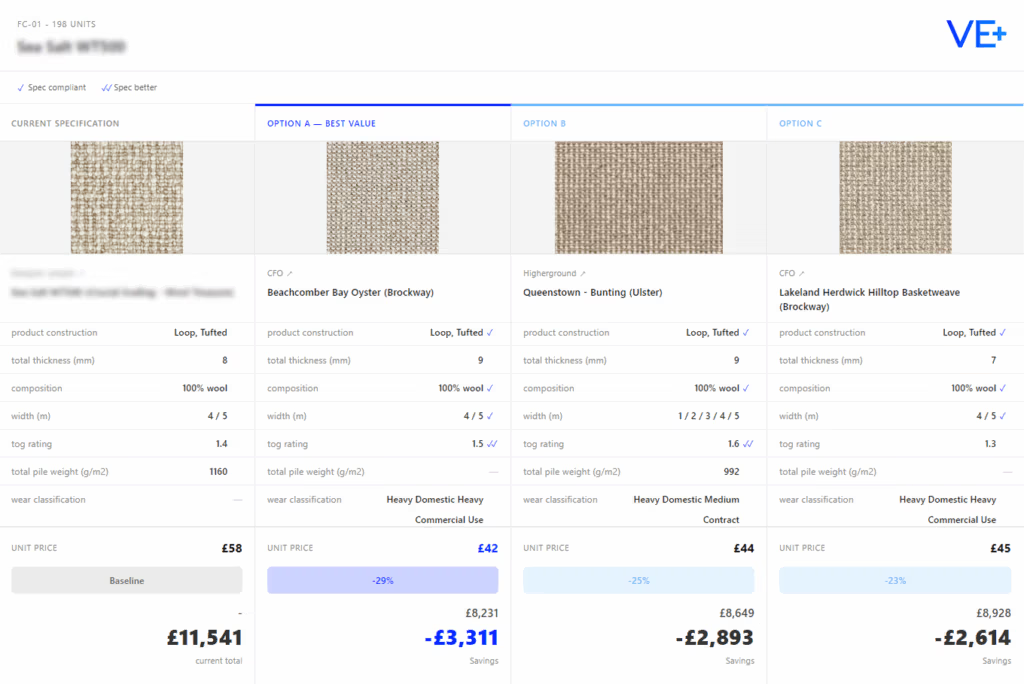
Where structured product data exists, the technology can already compare a technical brief against a far broader set of suppliers – assessing fit on specification, compliance, and visual criteria simultaneously. The effort of identifying viable alternatives, which currently consumes significant time across procurement and pre-construction teams, compresses considerably.
The shift this enables is not simply speed. It is a change in how the market is accessed. Procurement moves from being driven by who is already known to being driven by what actually fits the requirement. Technical comparison becomes more systematic and less dependent on individual relationships or manual outreach cycles.
Implications for the market
Suppliers with structured, accessible product data are better positioned in this environment. The visibility advantage that currently belongs to the most well-connected or most responsive suppliers shifts toward those whose data can be read, compared, and matched at scale.
Construction procurement will not simply become faster. It will become broader in market coverage, more transparent in how alternatives are surfaced, and less reliant on the manual discovery steps that currently limit it.