One of the less visible problems in construction procurement is that product information is often treated as an administrative detail rather than an operational infrastructure.
Fields like fire rating, slip resistance, composition, dimensions, acoustic performance, or tog rating rarely receive much attention outside technical reviews. They are not particularly exciting. But in practice, these small pieces of information sit underneath a large proportion of procurement and value engineering decisions made across a project.
When this information is incomplete, inconsistent, or buried inside PDFs, the process around it becomes slow almost by default.
A common example appears when a finishes package comes back over budget. A carpet specification, for instance, may suddenly need alternatives within a tight timeframe. On paper, this sounds straightforward. In reality, it often triggers a familiar chain reaction: subcontractors are contacted, supplier emails begin circulating, products are suggested that only partially match the brief, and someone eventually attempts to organise the information manually into a spreadsheet for comparison.
The issue is rarely a lack of effort. Most teams are already working under compressed timelines with fragmented information spread across multiple formats and supplier systems. Under those conditions, even relatively simple comparison exercises become surprisingly labour-intensive.
The limitation is structural.
Construction procurement still relies heavily on information that was never designed to be searched, filtered, or compared efficiently. Many product catalogues function more like brochures than datasets. Teams are expected to make precise technical and commercial decisions while navigating information environments that remain largely manual.
It is similar to trying to compare products in a supermarket where every label is written differently, organised in different aisles, and missing half the ingredients. The products exist, but the ability to evaluate them quickly becomes the real bottleneck.
When product data is structured properly, the dynamic changes considerably. Comparable alternatives can be surfaced much faster because the filtering logic already exists. Technical compliance, visual intent, and budget constraints can all be assessed simultaneously rather than sequentially.
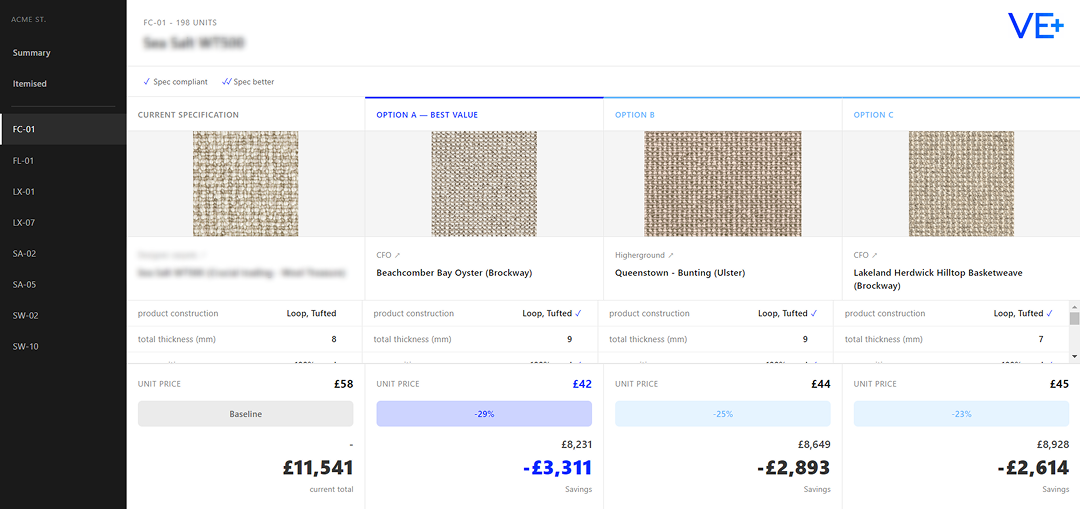
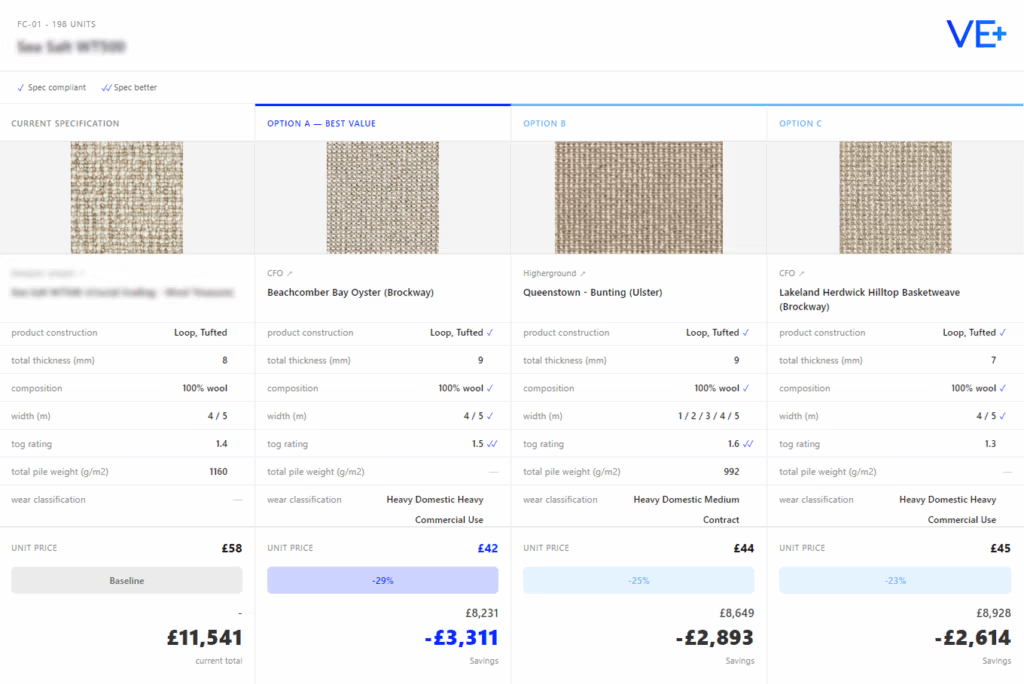
On a recent project, this became visible through a relatively small finishes exercise. A carpet specification exceeded budget expectations, but because the underlying product attributes were already organised and comparable, suitable alternatives could be identified quickly without restarting the sourcing process from scratch. Equivalent options aligned with the original technical and aesthetic requirements were surfaced within minutes, creating meaningful savings on a single product line without requiring redesign or extended coordination.
Individually, these moments can seem minor. But scaled across entire schedules, packages, and procurement cycles, the operational value of accessible product information becomes much more significant.
At VE+, this is one of the core realities shaping the approach. Many procurement delays are not caused by lack of market options, but by the difficulty of navigating fragmented product information quickly enough for modern project timelines.