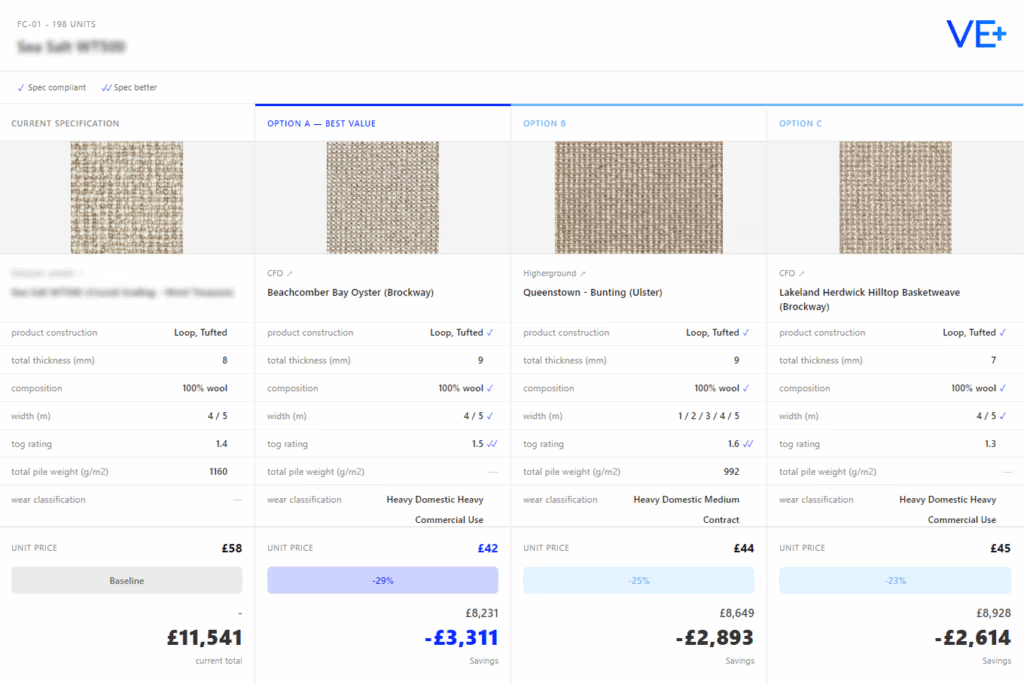
There is a recurring frustration I hear in almost every conversation with QSs and pre-con teams. Everyone agrees that exploring value alternatives earlier would lead to better outcomes. Better cost certainty. Better commercial decisions. Fewer late compromises. And yet, it rarely happens in practice.
This is not because people do not care. It is because of how time actually behaves inside a live project.
By the time a finishes package reaches pre-con or procurement, pressure is already baked in. Programmes are tight. Tender deadlines are fixed. Information is partial. And finishes, while often a significant chunk of the budget, are only one of many packages competing for attention at the same time.
When time is limited, teams naturally default to what is quickest to validate.
Properly sourcing value alternatives is rarely quick. It is not just about finding something cheaper. It is about understanding what the specified product is really doing, then testing the market to see what else genuinely meets those same requirements. That means scanning broadly, not just calling one or two familiar suppliers. It means reviewing dozens of possible options, filtering them by performance, compliance, aesthetics, availability, and cost, and then narrowing that down to a small number that are actually viable.
In practice, this involves contacting a lot of suppliers. Waiting for responses. Chasing technical data. Comparing documents that are rarely structured in the same way. Discovering that many products fall out once you look closely. What seems like a simple exercise quickly turns into a deep, time-consuming market review.
QSs and pre-con teams understand the value of doing this work properly. The problem is that the effort required rarely matches the time available. When you are managing multiple packages, cost plans, scope clarifications, and tender queries in parallel, it becomes extremely difficult to justify spending days scanning the market for finishes alternatives, even when the potential savings are clear.
As a result, value alternatives tend to be explored lightly, based on limited reach or prior knowledge, or they are left until very late in the process when options are already constrained. At that point, decisions become reactive rather than considered.
This is not a criticism of the people doing the job. It is a reflection of the system they are working within. The industry expects deep market insight, but it rarely creates the time or structure needed to achieve it.
At VE+, we are trying to face this reality head-on. Not by asking QSs and pre-con teams to do more, but by rethinking how deep market scanning for value alternatives can happen without adding pressure to already stretched teams. That belief is what drives everything we are building.